Quiet Neighbours, Live Floors: Planning Powered Access Around Occupied Premises
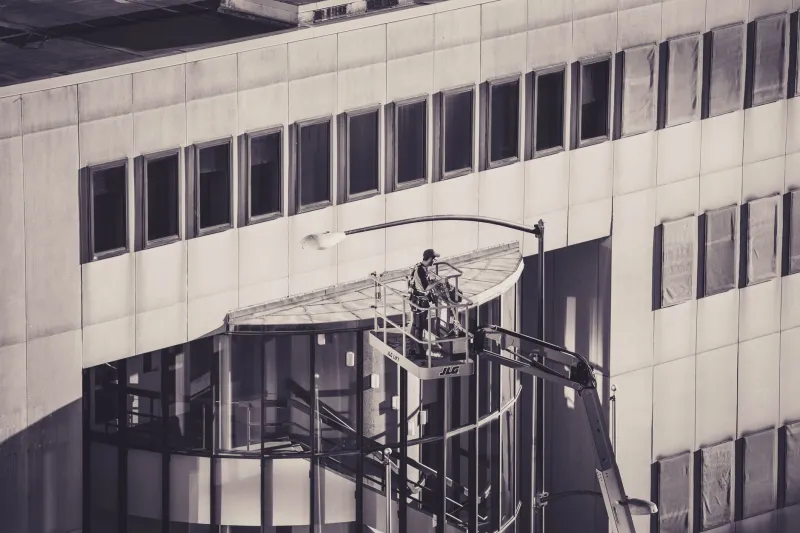
Powered access in an occupied building is rarely judged solely on whether the task was completed safely. Tenants, customers and neighbouring businesses experience the work through sound, vibration, dust, lighting and the temporary loss of a lift lobby or loading bay. For facilities managers and contractors, the technical access plan therefore sits alongside a disturbance plan. The objective is not to eliminate all impact—that is seldom realistic—but to make the impact predictable, agreed and evidenced.
Survey the building as a working environment
Before selecting a scissor lift or boom, walk the route as a tenant would experience it. The pre-work survey should record more than floor loading and doorway widths. It should identify sensitive occupied areas: meeting rooms, clinics, server rooms, retail frontages, reception desks, studios and any space where concentration or confidentiality matters. Note the building’s normal sound profile at different times of day, the location of shared walls and the routes used for deliveries and waste. Photograph existing condition where vibration or marking could later be alleged.
Review the lease and building rules early. Service charge arrangements, permitted working hours, approval routes for access equipment and restrictions on loading bays may all affect the programme. Where the building is multi-let, the landlord or managing agent may require a method statement before consent is given. The survey should also confirm how the MEWP will enter the building, where it will be charged or refuelled, and whether floor protection or route matting is needed. A machine that is technically suitable for the task may still be unsuitable for the building if its alarms, tyres or manoeuvring space create avoidable disturbance.
Agree the communication before the schedule
Tenant communication should be specific, timed and two-way. A generic notice in a lift lobby is rarely sufficient for work that will be heard or felt inside occupied suites. The communication plan should name a contact for each affected tenant, set out the nature and duration of the work, identify the noisiest activities, and explain how questions or complaints will be handled. Where works affect customer-facing areas, the wording may need to be agreed with the tenant’s own operations team.
Records matter. Keep copies of notices, acknowledged emails, meeting notes and any agreed variations to working hours. If a tenant asks for work to be paused during a presentation or a delivery window, record that request and the response. This is not bureaucracy for its own sake; it demonstrates that the contractor and facilities team considered the building as a live environment rather than treating occupation as an inconvenience. A short weekly lookahead, issued to tenant contacts, is often more effective than a long method statement issued once.
Schedule around the business, not around the contractor
Working hours should be derived from the building’s pattern of use, not simply from the contractor’s preferred shift. In some premises, early-morning starts avoid customer traffic; in others, evening work creates security and lone-working issues. The assessment should weigh disturbance against fatigue, supervision and the availability of building services. Out-of-hours working is not automatically quieter if it introduces poor lighting, rushed tasks or reduced oversight.
Where full out-of-hours working is not feasible, micro-scheduling can reduce friction. Batch noisy activities into agreed windows, avoid peak trading periods, and separate deliveries from times when lifts and corridors are busiest. Consider whether a smaller electric machine can replace a larger diesel unit, or whether a task can be sequenced so that the noisiest element is completed in one visit rather than several. The schedule should be realistic: an over-compressed programme may save a day of disturbance but increase the risk of rushed set-up and poor communication.
Control noise and vibration at source
Equipment selection is the first control. Battery-electric scissor lifts and low-noise MEWPs are often appropriate for internal works, but their alarms and beacons still need thought. Warning devices should be set to suit the environment and the risk assessment; they should not simply be muted to keep the peace. Non-marking tyres, route matting and speed limits can reduce both vibration and damage claims. Maintenance also matters: a poorly maintained machine may squeak, judder or emit hydraulic noise that a well-serviced unit would not.
Worker exposure remains subject to the Control of Noise at Work Regulations 2005, while tenant disturbance may engage lease terms and, in some circumstances, statutory nuisance provisions under the Environmental Protection Act 1990. Contractors should not present a tenant complaint as a purely commercial matter. The practical response is to investigate promptly, distinguish unavoidable from preventable disturbance, and record any corrective action. Dust, lighting and temporary exclusion zones should be managed alongside sound and vibration, because complaints often combine several effects.
Build an evidence file that can answer a complaint
A defensible disturbance record does not need to be elaborate, but it should be consistent. Retain the pre-work condition survey, the tenant communication log, the agreed schedule, the access equipment specification, the risk assessment and method statement, and any noise or vibration checks carried out. If a complaint is received, record the time, location, alleged effect and immediate response. Follow up with the tenant and note what changed. At completion, a short close-out record with photographs and tenant sign-off can prevent disputes from resurfacing weeks later.
Close out with a shared record
The measure of success is not silence at any cost. It is a programme in which tenants knew what was coming, the contractor controlled what could reasonably be controlled, and both parties can see how decisions were made. Facilities managers should ask for that evidence before the MEWP leaves site, not after a complaint arrives. Quiet operation is ultimately a process: survey the live building, communicate in advance, schedule around occupation, control the machine and keep a record that stands up to scrutiny.