Reading Wind Twice: Defensible Stop-Go Decisions for Urban MEWPs
Wind on an urban powered-access job is rarely a single, tidy number. A forecast may describe the postcode, a handheld anemometer may sit in the shelter of a street canyon, and the platform itself may be exposed to a building-corner gust that neither source captures. The practical question for facilities teams and contractors is not simply what the wind speed is, but whether the decision to continue, pause or stand down can be reconstructed and defended afterwards.
That requires more than an instrument. It requires a deliberate reading strategy and a record of the reasoning behind the call.
The forecast is a planning input, not a site measurement
Weather forecasts and Met Office warnings are useful for scheduling, briefing and setting review points. They are not a substitute for site observation. A forecast may be accurate for a general area while understating acceleration between buildings or overstating exposure in a sheltered courtyard.
Use the forecast to decide whether the day is suitable in principle, whether additional monitoring is needed and whether a named person should review conditions at particular times. Record the forecast summary in the site paperwork, including any gust trend or weather warning. That record shows the conditions were anticipated, not ignored. It does not, however, justify continuing when a platform-level reading or observed conditions suggest otherwise.
Where the anemometer goes changes the answer
Anemometer placement is often the weakest link in wind monitoring. A reading taken at street level beside a tall building may be sheltered by the very geometry that makes the platform exposed. A reading taken on the roof may overstate conditions in a protected internal courtyard. Neither is automatically wrong, but each must be understood.
Where practicable, measure at or near platform height in a representative exposed position. If the MEWP has a manufacturer-fitted anemometer, use it in accordance with the manufacturer's instructions and confirm it is functioning during pre-use checks. Where a handheld instrument is used, position it clear of the operator's body, vehicles and building lee, and record the height and location of each reading. Take readings over a representative period rather than a single snapshot, and note both the general wind and the peak gust.
Calibration, battery condition and response time matter. So does honesty about limitations. A ground-level reading in a dense urban site should be treated as a lower-bound indicator, not as proof that platform conditions are acceptable. The reading becomes evidence only when its location, height, time and instrument are recorded alongside it.
Interpreting the manufacturer's wind-speed limit
The manufacturer's rated wind speed is a limit, not a target. Check the specific machine manual for the model in use. Some machines quote a maximum in-service wind speed; others set requirements for stowing or lowering the platform as conditions deteriorate. The basis of the figure may relate to steady wind, gust or a defined test condition. Do not assume that a generic Beaufort description maps neatly onto the machine's rating.
Payload, platform configuration and added equipment can affect wind exposure. Unauthorised signage, sheeting or other attachments increase sail area and may invalidate the manufacturer's assumptions. If the machine is rated for a particular maximum wind speed, that figure applies to the machine as configured and operated within its instructions. Manufacturer guidance takes precedence over general rules of thumb.
Where several MEWPs are on site, each may have a different rating. The briefing should identify the relevant limit for each machine and the action required as that limit is approached. Operators should know that the limit is not a comfort threshold to be tested.
Urban geometry: canyons, corners and changing exposure
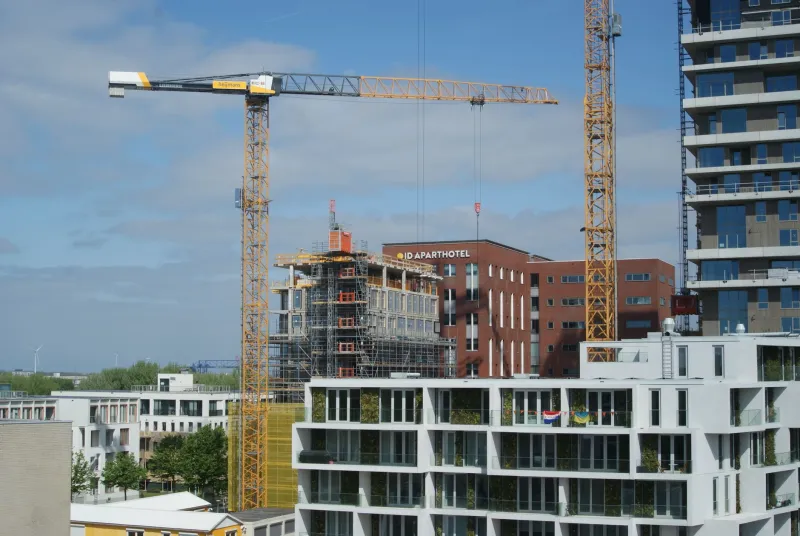
Urban sites produce local wind effects that a forecast cannot resolve. Long gaps between buildings can funnel and accelerate flow. Building corners can shed vortices and produce sharp, short-lived gusts. Openings, undercrofts, parapets and changes in roof level can create turbulence or downdraughts. A calm street-level morning can sit beneath a much stronger flow at platform height.
The practical response is to identify the exposed faces of the building and the locations where the platform will work. Position monitoring to reflect those locations, and reassess when the platform moves around a corner or when wind direction changes. Observe physical indicators as well as instruments: flags, trees, dust, loose materials, clothing and signage. These are not measurements, but they are useful corroboration and should be noted if they influence the decision.
A three-state stop-go framework
A defensible framework distinguishes between continuing, pausing and standing down.
Continue means readings are below the relevant manufacturer limit with an agreed margin, conditions are stable and a named person is monitoring at defined intervals. The review trigger should be stated, such as a gust threshold, a change in wind direction or a forecast update.
Pause means conditions are approaching a limit or the available readings are not representative enough to support continuation. The platform should be lowered or moved to a safer configuration where the manufacturer permits, the area should be secured and conditions should be re-read after a set interval. A pause is not a substitute for a stand-down if the uncertainty cannot be resolved.
Stand down means the manufacturer's limit has been reached or exceeded, a weather warning affects the site, representative measurement is not possible, or an unexpected gust has undermined confidence in the monitoring regime. The machine should be stowed and secured in accordance with the manufacturer's instructions, and restart criteria should be agreed before work resumes.
Recording the reasoning
A useful decision record is contemporaneous, attributable and specific. It should include the date and time, work area, MEWP identification and rated wind speed, task and platform height, forecast summary, instrument details and placement, readings including gusts, observed indicators, any notes on urban geometry, the decision taken, the person authorising it and the next review time or trigger.
For a pause or stand-down, record the restart criteria. For a decision to continue, record why the readings were considered representative or why a conservative margin was applied. If only a street-level reading was available, say so and explain what other evidence supported the call. A third party should be able to follow the trail without having been on site.
Briefing and handover
Wind should be included in the pre-use briefing and in shift handover. Operators and site supervisors should know who has authority to stop work and that anyone may raise a concern. A new shift should not reset the decision to continue without reviewing the current readings, forecast and monitoring arrangements. Facilities managers commissioning urban access work should ask contractors how wind decisions will be recorded and who will make them.
The test is straightforward: if work continued, paused or stopped, could the reason be explained later from the paperwork? A structured reading strategy and a clear decision record turn a difficult judgement into a defensible one.