The Right Platform for the Job: A Contractor’s Framework for Access Equipment Choice
Access equipment is often selected late in the planning process, when the programme is fixed and the budget is under pressure. That is precisely when poor choices are made. Scaffolding, mobile elevating work platforms and mast climbing work platforms are not interchangeable alternatives; they are different production tools with different ground, training, inspection and rescue implications. A structured comparison at selection stage reduces the risk of buying a solution that creates a new problem.
Start with the Task, Not the Plant
The first question is not which system is cheapest or most familiar, but what the task actually requires. Consider the geometry of the work area, the height and reach needed, the duration, the number of operatives, the materials to be handled and the frequency of movement. A short facade repair at 12 metres is a different problem from a six-month cladding programme at 40 metres. A single high-level inspection is different again from repetitive work along a long elevation.
Site conditions matter just as much. Ground bearing capacity, slopes, drainage, buried services, suspended slabs, public interfaces, overhead lines and wind exposure can each rule out an option before cost is considered. In 2026, contractors are also under pressure to demonstrate competence and inspection discipline to clients and principal designers. The equipment choice should be defensible on safety grounds, not merely convenient on price.
Scaffolding: The Known Quantity
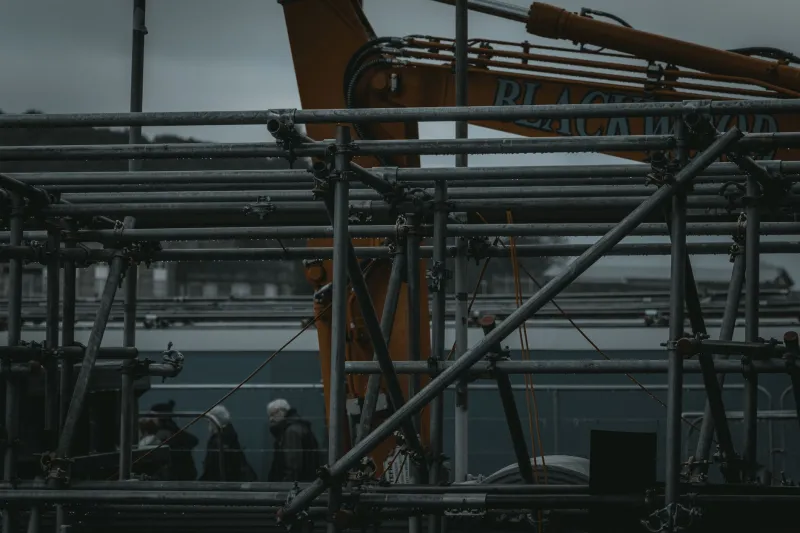
Scaffolding remains the default for many UK projects because it offers continuous access, material storage and the ability to support multiple trades over a sustained period. It can be adapted, sheeted or netted, and the workforce is generally familiar with it. For long-duration facade work, it can be highly productive.
Its limitations are equally clear. Erection and dismantling take time, ground loading must be designed, and ties or other stability measures must be installed correctly. Sheeting and netting increase wind loading, and access ladders or stair towers add to the planning burden. Scaffolds should be designed, erected, altered and dismantled by competent persons, with inspection at intervals not exceeding seven days and after events that may affect stability. In the UK, NASC guidance and TG20 are common references for tube-and-fitting scaffolds, but the specific design remains project-specific.
The headline hire rate for scaffolding can look attractive, but the total cost includes design, erection, dismantling, inspection, adaptation and the programme time consumed by those activities. For short tasks, that mobilisation burden can outweigh the apparent hire saving.
MEWPs: Flexibility with Discipline
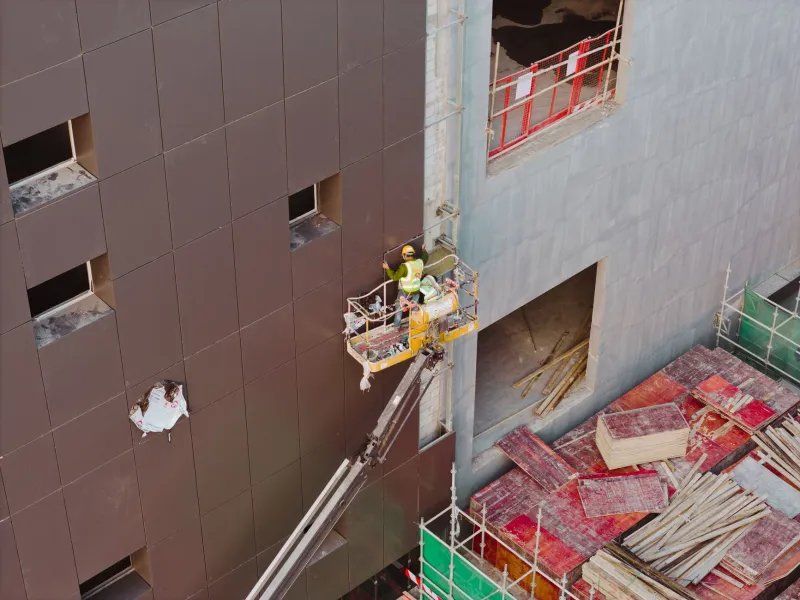
Mobile elevating work platforms offer rapid deployment, mobility and good reach for many maintenance and construction tasks. Scissor lifts suit internal or flat-ground work, while boom lifts provide outreach over obstacles. They reduce the need for continuous scaffold access and can be moved between tasks during the day.
MEWPs are not a low-supervision option. Ground conditions must be assessed, including floor loading for internal use and bearing pressure for outriggers or wheels. Wind limits apply, particularly for boom lifts with large platforms or materials. Rescue arrangements must be planned before the first ascent, and operatives need familiarisation with the specific model, not just a general ticket. IPAF training is widely recognised in the UK, but it does not replace site-specific instruction.
MEWPs fall primarily under PUWER, with pre-use checks and periodic inspection required. Some attachments or lifting operations may bring LOLER into scope, so the boundary should be checked rather than assumed. The key selection question is whether the machine can be positioned safely and productively for the whole task, not just the first lift.
Mast Climbing Work Platforms: The Vertical Production Tool
Mast climbing work platforms are designed for vertical production. They provide large working platforms that can be raised as the building rises, reducing the volume of scaffold required and improving productivity on repetitive facade work. They can be configured with multiple platforms and, in some cases, weather protection.
They are specialist equipment. Installation, ties to the structure, base loading, wind assessment and rescue arrangements all require competent design and planning. BS EN 1495 provides the product standard, and thorough examination and inspection regimes apply. Operatives and supervisors need specific training. Mast climbers can be highly efficient on the right project, but they are poor choices for short, irregular or lightly loaded tasks. Mobilisation and design costs are significant, and the programme must allow for installation, commissioning and dismantling.
A Decision Framework: Cost, Programme, Safety and Compliance
Cost should be compared on a whole-project basis. Include design, transport, erection or installation, hire, inspection, supervision, dismantling, downtime and the cost of any programme delay. A cheap MEWP with no local service support can become expensive if a breakdown stops work for two days.
Programme should be assessed against mobilisation time, production rate, weather sensitivity and removal. Scaffolding may be slow to erect but efficient over months. A MEWP may be quick to deploy but less productive where frequent repositioning is needed. A mast climber may offer high production rates but only after a substantial installation period.
Safety should consider fall prevention, rescue, public interface, ground stability, wind and fire risk. Compliance should confirm that the equipment can be designed, inspected, supervised and operated by competent people, with records available for the client and the enforcing authority.
Ground Conditions and Interfaces
Ground conditions are a common source of late change. A MEWP on a paved surface can be straightforward; a mast climber on a basement slab is not. Temporary works advice may be needed for spreader plates, mats, ties or foundations. Public footpaths, vehicle routes and site logistics must be considered alongside the equipment footprint.
Training and Inspection at Selection Stage
Ask who will erect, inspect, supervise and rescue. For scaffolding, CISRS cards and documented design checks are relevant. For MEWPs, IPAF or equivalent training should be matched with familiarisation. For mast climbers, manufacturer or specialist training is essential. If the inspection regime cannot be resourced, the equipment choice is wrong, regardless of the hire rate.
Contracting and Handover
Clear contractual responsibilities reduce disputes. Confirm who provides design, handover certificates, inspection records, maintenance and breakdown response. A handover that does not include rescue arrangements and emergency contacts is incomplete.
The best access choice is the one that fits the task, the site and the management arrangements. High Access Solutions’ experience is that early comparison, rather than late substitution, is what keeps access equipment safe, compliant and cost-effective on UK projects.