Beyond the Lanyard: Closing the Rescue Gap in UK Work-at-Height Planning

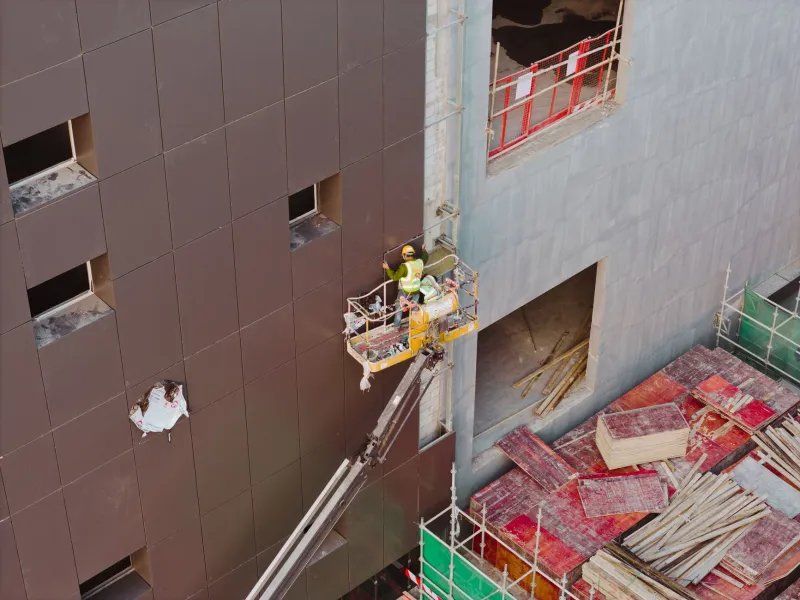
Photo: MEWP rescue equipment training construction site UK, via i.pinimg.com
Falls from height remain one of the most serious risks in UK workplaces, and most facilities teams rightly focus on preventing them. Yet a work-at-height plan that stops at guardrails, harnesses and permit controls answers only half the question. If prevention fails, the site must already know how to recover the casualty quickly, safely and without improvising.
Prevention Is Only Half of the Duty
For many facilities managers, the work-at-height plan is judged by its visible controls: the platform selected, the edge protection installed, the lanyard clipped to a suitable anchor. Those controls matter. But the Work at Height Regulations 2005 and supporting HSE guidance also require duty holders to think through foreseeable emergencies. A rescue that depends on a call to the emergency services, with no site-specific arrangements in between, is not a plan; it is an assumption.
This is the gap that often goes unnoticed until an incident. A fallen worker may be suspended in a harness, exposed to suspension trauma, or injured and unable to self-rescue. The clock starts immediately. Facilities managers, principal contractors and employers therefore need a rescue regime that is as practical and rehearsed as their fall-prevention measures.
What Rescue-Ready Actually Means
Rescue readiness is not a document in a folder. It is a capability made up of four elements: a site-specific rescue plan, suitable equipment, trained people and a rehearsed response. The plan should identify foreseeable fall scenarios, including falls from MEWPs, scaffolds, roofs, ladders and fragile surfaces. It should state who will respond, how they will reach the casualty, how the casualty will be lowered or retrieved, and how first aid and escalation will follow.
The plan also needs to be realistic about time. If the nearest trained rescue team is 45 minutes away, the site is relying on the casualty remaining conscious and stable for 45 minutes. That may not be acceptable. Where self-rescue is not possible, on-site or nearby rescue capability should be available within a timeframe that reflects the risk.
Equipment: Check Compatibility, Not Just Condition
Rescue equipment is often purchased in isolation and then left in a store. A davit, tripod, winch, rescue kit or controlled descent device is only useful if it is compatible with the anchor point, the harness and the casualty's position. A generic kit that nobody has fitted to the actual structure is a false comfort.
The inspection rhythm should mirror the seriousness of the equipment. Rescue equipment should be included in pre-use checks, detailed inspections and, where applicable, LOLER examinations. Records should show not only that an item was inspected, but that it remains suitable for the intended rescue. Facilities managers should also consider environmental conditions: a kit stored in a damp plant room or exposed to UV may not perform as expected when needed.
Training: Test Judgement, Not Just Repetition
Rescue training frequently focuses on the mechanics: attach the device, operate the winch, lower the casualty. These skills matter, but real incidents rarely follow the training-ground script. The casualty may be unconscious, the access route may be obstructed, or the available anchor may be in an awkward position. Training should therefore include scenario-based exercises that require responders to assess the situation, select equipment and communicate under pressure.
Refresher frequency should be risk-based. For sites with regular work at height, annual refresher training is a reasonable baseline, but higher-risk operations may justify more frequent practice. The key test is whether responders can act without referring to a manual while the clock is running.
Common Pitfalls That Leave Sites Exposed
The first pitfall is assuming that emergency services will perform the rescue. They may attend, but they are not a substitute for a site-specific plan. The second is a plan that names an external rescue provider without confirming response times, access arrangements or equipment compatibility. The third is untrained or partially trained staff who know a rescue kit exists but have never deployed it.
Other frequent failures include rescue plans that cover only one type of access equipment, no consideration of suspension trauma, and no method for recovering a casualty from a confined or awkward location. Paperwork can also create an illusion of compliance: a generic rescue plan copied from another site may satisfy an audit checklist while bearing no relation to the actual building.
A Practical Rescue-Readiness Checklist
A useful starting point is to ask these questions at the next work-at-height review:
- Does the rescue plan identify specific fall scenarios for each work area?
- Is the rescue method compatible with the access equipment and anchor points?
- Are rescue equipment inspections recorded and in date?
- Are enough people trained to deploy the equipment, including cover for leave and shift patterns?
- Has the plan been tested in a realistic exercise within the last 12 months?
- Are response times from any external provider verified in writing?
- Is there a clear route for first aid, casualty handling and incident escalation?
Making Rescue Part of the Culture
Rescue readiness should not be a bolt-on to the safety file. It belongs in inductions, toolbox talks and project reviews. When operatives know who the rescuers are, where the equipment is kept and how a rescue is triggered, the plan becomes operational rather than theoretical. For facilities managers, the objective is simple: if prevention fails, the site should already know what to do.