A Reserve Descent, Not an Assumption: Verifying MEWP Auxiliary Lowering on UK Sites
The feature everyone expects, few can describe
Ask a site team how a mobile elevating work platform will be lowered if its primary power or hydraulic function fails, and the answer is often a confident variation on: “It has an emergency lowering lever.” Ask where that lever is, who has operated it, when it was last tested, and what the landing area should look like, and the confidence tends to evaporate.
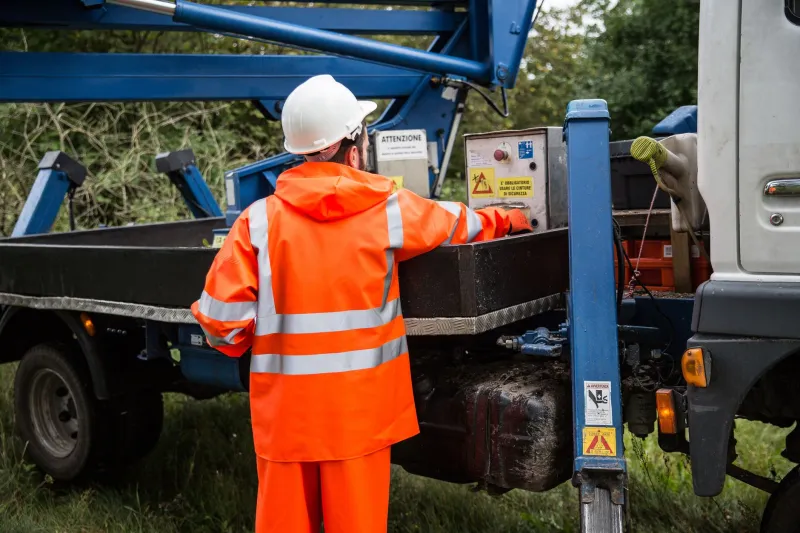
Auxiliary lowering systems are a sensible and well-established part of MEWP design. They are not, however, a universal guarantee. The method varies by machine type, manufacturer and model: some use a manually operated pump, some an auxiliary battery circuit, some a controlled bleed or gravity-lowering arrangement. The controls may be in the platform, at the ground station, or both. The permitted use may depend on the platform position, the load, the ground conditions and the nature of the fault.
For facilities managers and contractors, the practical issue is not whether auxiliary lowering exists in principle. It is whether the particular machine on site has a verified, understood and briefed second way down before anyone needs it.
What the system is, and what it is not
Auxiliary lowering is a controlled means of bringing the platform down when normal operation is unavailable. It is not a substitute for routine maintenance, nor is it a general-purpose rescue method for every emergency. If a person has become unwell, is suspended in a harness, or the machine has suffered structural damage, lowering the platform may be only one part of the response. The rescue plan still has to address casualty care, access, communication and the possibility that lowering is not the right immediate action.
It is also not a single procedure that can be taught generically across a mixed fleet. A brief familiarisation on one model does not qualify a supervisor to operate the auxiliary controls on another. The manufacturer’s instructions remain the controlling reference, and the site’s arrangements should reflect the actual machines delivered.
The handover gap: availability versus verification
Hire handover is where assumptions commonly take root. The machine arrives, the primary controls are demonstrated, the paperwork is exchanged and the platform is put to work. Auxiliary lowering may be mentioned in passing, or it may be covered by a line in the manual that nobody opens until something goes wrong.
A more defensible handover separates three questions:
- Is the system fitted, and in what form? The machine’s identification details, control layout and manufacturer instructions should make this clear.
- Has it been checked by the right person? An operator’s pre-use check is not the same as a competent maintenance test. The former is about identifying obvious defects before use; the latter is about confirming function and condition within the manufacturer’s regime.
- Who on site is authorised and briefed to use it? Availability without a named, trained person is not operational assurance.
For a facilities team, it is reasonable to ask the hire supplier to identify the auxiliary lowering method at delivery and to provide the relevant extract from the machine instructions. That does not replace the operator’s duties, but it gives the site a document to brief against rather than a verbal assumption.
Pre-use checks: what an operator can reasonably confirm
Pre-use verification should be proportionate and follow the manufacturer’s guidance. It typically includes confirming that the auxiliary controls are present, undamaged, clearly marked and accessible; that any auxiliary power source or manual pump appears serviceable; and that the platform is not carrying an unfamiliar modification or obstruction around the controls.
Where the manufacturer permits a function check without putting anyone at risk, that check should be carried out in accordance with the instructions, in a suitable location and with the area below controlled. Operators should not improvise a test, operate controls they have not been trained on, or lower a platform from height simply to prove that a lever moves.
Any defect, missing label, stiff control or unclear instruction should be recorded and escalated. The machine should not be treated as having a reliable second way down until the issue is resolved.
Competent testing and the record trail
Auxiliary lowering systems should be included in the machine’s maintenance and examination regime as specified by the manufacturer. That is work for a competent person, not a task to be absorbed into a site induction or a toolbox talk.
Records should allow a site to answer four questions without hunting through email chains:
- Which machine was tested, identified by its unique reference?
- What method of auxiliary lowering does it use?
- When was the system last checked, and by whom?
- What was the result, and what instructions apply to its use?
This record sits alongside, not instead of, the machine’s thorough examination and inspection history. A clean primary function does not prove that the reserve descent will work. Conversely, a recent auxiliary test does not remove the need for pre-use checks or for a site-specific rescue plan.
Briefing the second way down
Site briefing should be short, specific and repeatable. It should identify the auxiliary controls on the actual machine, the sequence in the manufacturer’s instructions, the conditions in which use is permitted, and the person or role authorised to decide on use. It should also cover the landing area: where the platform will come down, what is beneath it, who needs to be excluded, and how communication will be maintained.
A useful briefing does not attempt to turn every operative into a maintenance technician. It gives people enough knowledge to recognise the system, follow the correct instruction and escalate when the situation falls outside it.
Contractual assurance before the machine arrives
Procurement is the natural place to close the gap. Hire agreements and supplier conversations can confirm the auxiliary lowering method for each machine, the availability of manufacturer instructions, the maintenance and testing regime, and the breakdown response arrangements. For facilities teams managing occupied premises, it is also worth confirming how a stranded platform would be recovered if the auxiliary system itself were unavailable.
That is not about inventing a parallel rescue service. It is about ensuring the site’s emergency plan is built on verified machine information rather than a hopeful assumption.
A practical audit prompt
Before the next MEWP arrives, a site team can usefully ask: can we name the auxiliary lowering method for this machine, show the instruction, identify who is briefed to use it, and evidence when it was last competently tested? If any of those answers depends on memory or a general belief that “they all have one”, the second way down is not yet assured.
High Access Solutions works with UK facilities and contracting teams to make access decisions explicit, recorded and usable on site. Auxiliary lowering deserves the same treatment: not a footnote in the manual, but a verified part of the plan.